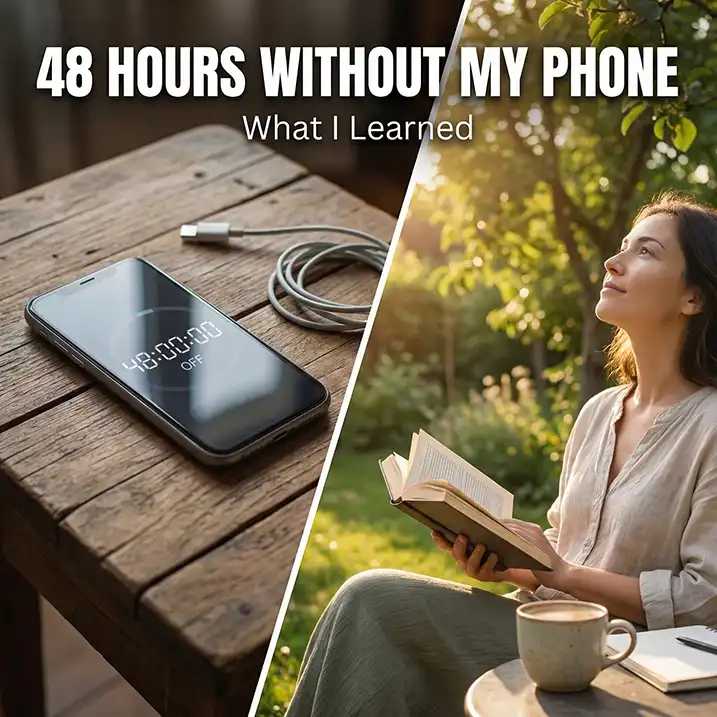
We touch our phones an average of 2,617 times a day. I realized I was part of that statistic when I found myself refreshing Instagram while watching a movie and eating dinner.
My attention span was shattered. My anxiety was humming in the background like a refrigerator I couldn’t unplug. I knew I needed a reset. Not just an hour away, but a hard stop.
So, I decided to conduct an experiment. I committed to spending 48 hours without my phone. No social media, no texts, no maps, and no podcasts.
I expected to feel bored. I didn’t expect to feel like a completely different person. Here is exactly what happened during my weekend disconnected from the digital world.
The Rules of the Experiment
Before diving into the experience of 48 hours without my phone, I had to set some ground rules to ensure I didn’t cheat.
- The Device: My smartphone was turned off and placed in a locked drawer.
- Communication: I told my close family I would be offline. I kept a “dumb phone” (an old Nokia) strictly for genuine emergencies.
- Tools: I had to use analog alternatives. A physical alarm clock, a paper notebook, and a wristwatch.
Day 1: The Phantom Vibration and The Itch
The first morning was the hardest. Usually, I grab my device before my eyes are fully open.
Waking up during these 48 hours without my phone felt eerie. The room was silent. There were no notifications to check, no emails to dread, and no news headlines to spike my cortisol levels.
The Withdrawal Symptoms
By 10:00 AM, the “itch” set in. I found my hand unconsciously patting my pocket every ten minutes. This is often called “phantom vibration syndrome,” where your brain anticipates a notification that isn’t there.
I felt disconnected. I felt anxious. I wondered if I was missing out on something important. This fear of missing out (FOMO) is a recognized psychological stressor.
Note: If you try this, expect the first 6 hours to be physically uncomfortable. Your brain is craving its dopamine hit.
To distract myself, I went for a walk. Without a podcast playing in my ears, I actually heard the birds. I noticed the architecture of the buildings in my neighborhood. It sounds cliché, but the world looked higher in resolution.
Why Living 48 Hours Without My Phone Changed My Focus
By the afternoon of the first day, the anxiety began to fade, replaced by a strange sensation: boredom.
We have forgotten how to be bored. Usually, the second a moment of stillness arrives, we fill it with a screen. But boredom is actually a precursor to creativity.
For the first time in months, I sat down and wrote. Not a caption, but actual journal entries. My focus wasn’t fragmented.
Deep Work vs. Shallow Work
I realized that my phone forces me into “shallow work”—constantly switching tasks. Living 48 hours without my phone forced me into “deep work.”
I finished a book I had started three months ago. I cleaned my apartment without stopping to check Twitter every time I finished a room. The productivity boost was undeniable.
If you are interested in boosting your own efficiency, check out our guide on [Internal Link: increasing productivity naturally].
Day 2: The Mental Clarity and Sleep
The most shocking result of spending 48 hours without my phone came on the second morning.
I slept for 8 hours straight.
Blue light from screens suppresses melatonin, the hormone that controls your sleep-wake cycle. According to the Sleep Foundation, removing screens before bed significantly improves sleep quality.
I didn’t just sleep longer; I slept deeper. I woke up feeling rested, not groggy.
Reconnecting with Real People
On Sunday, I met a friend for coffee. Usually, our phones sit on the table like a third wheel. If the conversation lulls, we check our screens.
Without my device, I was forced to be 100% present. We maintained eye contact. The conversation went deeper than usual because I wasn’t half-distracted by a vibrating pocket.
It made me realize how often I “phub” (phone snub) the people I care about.
The Scientific Benefits of Disconnecting
My experience wasn’t just a placebo effect. Science backs up the benefits of a digital detox.
- Lower Cortisol: Constant notifications keep your body in a state of “fight or flight.”
- Improved Memory: Without the constant influx of new information, your brain has time to process and store memories.
- Better Posture: No “text neck” for two whole days.
Completing 48 hours without my phone proved to me that my device is a tool, but I had let it become a master.
How to Survive 48 Hours Without Your Phone
If you want to try this challenge, you need to prepare. You cannot just wing it, or you will cave in.
1. Pre-plan Your Navigation
We rely on GPS for everything. If you plan to go out during your 48 hours without my phone, look up the directions beforehand and write them down. It feels like an adventure.
2. Inform Your Circle
Tell your boss, partner, and parents. This prevents panic and stops you from worrying that people are trying to reach you.
3. Buy an Alarm Clock
Don’t use the excuse “I need my phone to wake up.” Buy a cheap analog clock.
4. Replace the Habit
When you feel the urge to scroll, have a replacement ready. A book, a stress ball, or a glass of water.
What I Learned: The Final Verdict
The experiment ended on Monday morning. Turning my phone back on was overwhelming. A flood of notifications poured in—mostly junk emails, memes, and irrelevant updates. I realized I hadn’t missed anything vital.
48 hours without my phone taught me three crucial lessons:
- Urgency is an illusion. Most things can wait.
- My attention is currency. I was giving it away for free to apps designed to steal it.
- Real life is slower, but richer.
I won’t be throwing my smartphone in the river. It is a necessary tool for modern life. However, I have changed my relationship with it. I no longer sleep with it in the room. I have turned off all non-human notifications (apps, news, games).
Conclusion
Are you brave enough to try 48 hours without my phone? It might sound terrifying, but the mental clarity waiting on the other side is worth the initial discomfort.
You will reclaim your time, your sleep, and your mind.
If you aren’t ready for a full 48 hours, try starting small. Check out our article on [Internal Link: 3 simple steps to reduce screen time] to get started gently.
The digital world will still be there when you get back. But your life is happening right now—don’t miss it.
You might like this:
Why Your Phone Shows News on Lock Screen? 5 Exact Fixes to Stop It