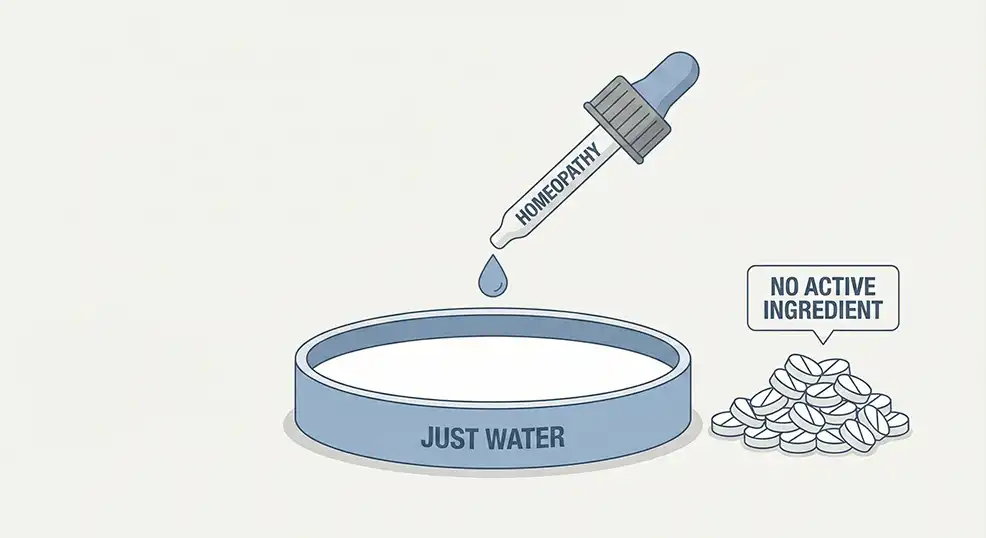
It is a multi-billion dollar industry wrapped in the allure of natural healing. Millions of people swear by it, claiming it cured their chronic headaches, allergies, or anxiety. Yet, when you strip away the anecdotal success stories and look strictly at the chemistry and physics, the picture changes dramatically. The scientific consensus is overwhelming, yet the controversy persists. If you are looking for an evidence-based answer to the question of why homeopathy doesn’t work, you have come to the right place.
In this deep dive, we aren’t just looking at opinions; we are looking at the hard data, the impossible mathematics, and the psychology that keeps this industry alive.
What Is Homeopathy? (And What It Isn’t)
Before we explain the failure of efficacy, we have to understand what we are actually debating. Many people confuse “homeopathy” with “herbal medicine.” This is a crucial distinction. Herbal medicine uses measurable amounts of plant material (like willow bark or ginger) to affect the body. Homeopathy does not.
Invented in 1796 by a German physician named Samuel Hahnemann, homeopathy is built on two pillars that defy modern science: “Like Cures Like” and “The Law of Infinitesimals.” The central premise is that a substance that causes symptoms in a healthy person can cure those same symptoms in a sick person—but only if it is diluted to the point of non-existence. This brings us to our first major point regarding why homeopathy doesn’t work: the basic laws of physics.
1. The Mathematical Impossibility of Dilution
The most damning evidence against homeopathy is found in basic high school chemistry. Homeopathic remedies are prepared through a process of serial dilution. A substance is mixed with water or alcohol, shaken (a process they call “succussion”), and then diluted again.
Common homeopathic potencies are labeled “30C.” The “C” stands for the Roman numeral 100.
- A 1C dilution is 1 part substance to 99 parts water.
- A 2C dilution is 1 part of that 1C mixture to 99 parts new water.
- A 30C dilution repeats this process 30 times.
The Avogadro Limit
To understand why homeopathy doesn’t work at these potencies, you have to look at Avogadro’s number ($6.022 \times 10^{23}$), which defines the number of atoms in a mole of a substance.
By the time you reach a dilution of 12C or 13C, you have surpassed the statistical probability of a single molecule of the original substance remaining in the solution. At 30C, the dilution is $1$ in $10^{60}$. To ensure you consumed just one molecule of the original “medicine” at 30C, you would have to drink a volume of water larger than our entire solar system.
When you buy a homeopathic remedy, you are purchasing a sugar pill that has effectively never touched the ingredient listed on the box.
2. The Myth of “Water Memory”
When confronted with the math above, homeopaths often pivot to a concept called “water memory.” They argue that while the physical substance is gone, the water retains an “imprint” or “memory” of the substance’s energy.
This claim is physically impossible. Water molecules are in a constant state of flux, breaking and reforming hydrogen bonds roughly every picosecond (one trillionth of a second). Liquid water does not have the structural stability to hold a “memory” of anything.
Furthermore, water on Earth has been recycled for billions of years. It has contained dinosaur urine, toxic waste, bacteria, and every organic substance imaginable. If water retained the memory of everything it touched, a single glass of tap water would be a toxic cocktail of everything that has ever existed. The fact that water is selective—remembering the onion extract but forgetting the sewage it was once part of—is a logical fallacy that highlights why homeopathy doesn’t work.
3. The Placebo Effect: Why It Feels Like It Works
If the pills are just sugar, why do your friends claim it cured them? This is the most persuasive part of the scam. The reason isn’t the pill; it’s the mind.
The placebo effect is a powerful psychobiological phenomenon. If you genuinely believe a treatment will help you, your brain can release endorphins, reduce stress hormones, and actually dampen pain signals.
Regression to the Mean
Another reason people believe in homeopathy is “regression to the mean.” Most common ailments—colds, headaches, back pain—are self-limiting. They get worse, peak, and then get better on their own.
People usually seek treatment when their symptoms are at their worst (the peak). If they take a homeopathic pill at that peak, and the natural healing process begins the next day, they attribute the cure to the pill. In reality, they would have recovered anyway. This misattribution of cause and effect is a primary reason why homeopathy doesn’t work in clinical trials but thrives in anecdotes.
4. Failed Clinical Trials and Reviews
We don’t have to guess about efficacy; we have tested it. Rigorous, double-blind, randomized control trials (RCTs) are the gold standard of medicine. In these studies, neither the doctor nor the patient knows who is getting the real medicine and who is getting the sugar pill.
When homeopathy is subjected to high-quality RCTs, it consistently fails to perform better than a placebo.
- The Australian NHMRC Review: In 2015, the National Health and Medical Research Council of Australia assessed over 1,800 studies. Their conclusion was stark: there is “no reliable evidence that homeopathy is effective” for any health condition.
- The Lancet Study: A massive meta-analysis published in the prestigious medical journal The Lancet compared 110 homeopathy trials with 110 conventional medicine trials. The conclusion was that the clinical effects of homeopathy are compatible with the placebo hypothesis.
If you are interested in reading more about evidence-based treatments, check out our guide on Real Science vs. Pseudoscience in Healthcare.
5. Inconsistency in Diagnoses
Another major red flag explaining why homeopathy doesn’t work is the lack of consistency among practitioners.
In conventional medicine, if you go to five different doctors with a broken leg, they will all diagnose a broken leg and recommend a cast. In homeopathy, studies have shown that if you visit five different homeopaths with the same symptoms, you will likely walk away with five different prescriptions.
There is no standard protocol because the practice relies on subjective interpretation of personality quirks rather than physiological pathology. One homeopath might prescribe Arnica because of your physical bruise, while another prescribes Natrum Muriaticum because you seem “emotionally reserved.” This subjectivity renders it scientifically untestable and clinically unreliable.
6. The Danger of “The Natural Fallacy”
One of the most dangerous arguments used to defend homeopathy is, “What’s the harm? It’s just natural.”
The harm lies in the opportunity cost. When patients choose homeopathy, they are often rejecting or delaying conventional medicine. There have been tragic, documented cases of parents treating their children’s severe infections or asthma with homeopathic pellets, resulting in hospitalization or death that could have been easily prevented with antibiotics or inhalers.
The FDA has cracked down on this recently. In fact, the FDA currently states that homeopathic products are not approved for safety or effectiveness. They are not subjected to the rigorous testing that real pharmaceuticals must undergo.
7. It Is Economically Incentivized to mislead
Finally, we must address the financial “scam” aspect. Manufacturing homeopathic pills is incredibly cheap. You are essentially packaging lactose tablets and water. The profit margins are astronomical compared to conventional drugs that require billions of dollars in R&D and safety testing.
Companies selling these remedies have a vested interest in maintaining the illusion. They use complex jargon and Latin names to mimic real medicine, confusing consumers into thinking they are buying a regulated pharmaceutical product. This deception is the core reason why homeopathy doesn’t work as a medical system—it functions more like a marketing machine.
Breaking Down the Arguments: A Quick Comparison
To make this easier to digest, let’s look at a direct comparison between how real medicine functions versus the homeopathic model.
| Feature | Conventional Medicine | Homeopathy |
| Active Ingredient | Measurable, standardized dose. | Often zero molecules present. |
| Mechanism | Biological and chemical interaction. | “Spiritual” or “Energy” based. |
| Testing | rigorous clinical trials (Phase I-III). | Mostly anecdotal or flawed studies. |
| Regulation | Strict FDA approval required. | Limited oversight as “supplements.” |
| Outcome | Proven to cure or manage disease. | performs equal to placebo. |
Conclusion: Trust Evidence, Not Magic
It is natural to want a cure that is gentle and devoid of side effects. We all want to believe in a simple solution. However, believing in something doesn’t make it true. The reality of why homeopathy doesn’t work is grounded in the immutable laws of our universe. You cannot dilute a substance into nothingness and expect it to become more powerful. You cannot teach water to remember flowers but forget feces.
While the placebo effect is real and can provide subjective relief for minor issues, relying on sugar pills for genuine medical conditions is a gamble with your health. The next time you see a shelf of homeopathic remedies, remember: you are effectively paying for expensive sugar. Save your money for treatments that have stood the test of rigorous scientific inquiry.
For more insights into digital marketing strategies for health blogs and debunking myths, visit our Blog Section.
FAQ
Q: Does homeopathy work for babies or animals?
A: This is a common myth used to argue against the placebo effect. However, animals and babies react to the tone, comfort, and care of the parent or owner (conditioning), which acts as a placebo by proxy.
Q: Why is homeopathy still legal if it’s a scam?
A: It is largely regulated as a supplement or distinct category, thanks to historical grandfathering laws. However, agencies like the FTC in the US now require labels to state that there is no scientific evidence for the claims.
Q: Can I use homeopathy alongside real medicine?
A: As long as it doesn’t delay real treatment, the pills themselves are usually harmless (inert). The danger is purely in replacing effective care with ineffective sugar pills.
You might like this…
Ashwagandha vs. L-Theanine: The Ultimate 2026 Guide to Beating Stress