

Let’s be honest: my life was a productivity graveyard.
My calendar was a mosaic of good intentions and forgotten tasks. My to-do list looked more like a “wish list” I’d never get to. We’re all drowning in this digital chaos, constantly hearing about a new “life-changing” app or “ultimate” productivity hack.
I was tired of it. I was tired of the “Sunday Scaries,” trying to map out a week I knew I’d abandon by Tuesday.
Then I had a brilliant, or possibly terrible, idea. What if I could just… outsource it? Outsource my entire life? And so, I embarked on a 7-day experiment: I decided to let an AI plan my entire week.
I didn’t just ask for a to-do list. I wanted the full experience. I used a combination of ChatGPT-4o to handle the high-level strategy and a popular scheduling app to import and live by its commands.
My one, simple rule: I had to follow the AI’s plan. Exactly. No matter how weird or inconvenient.
My goal was to unlock superhuman productivity, to finally get things done. My reality? A non-stop, seven-day comedy of errors that taught me more about being human than about being productive.
Here’s the full, unvarnished story of how my grand AI plan my week experiment went completely and hilariously off the rails.
The Grand Plan: Crafting the ‘Perfect’ Prompt for My AI Overlord
I didn’t go into this lightly. I was a scientist, and this was my experiment. I spent an hour crafting the perfect “master prompt” that would feed the AI all my hopes, dreams, and obligations.
I needed it to know everything.
My “Master Life” Prompt:
“You are my elite executive life assistant. Your goal is to make me 100% efficient and productive. Plan my entire 7-day week, from 7 AM to 11 PM, in 30-minute blocks.
My Core Goals:
- Work (My Job): Schedule 25 hours of ‘deep work’ for my client projects.
- Work (My Blog): Schedule time to write one 1,500-word blog post.
- Fitness: 3 x 45-minute gym sessions (cardio + weights).
- Learning: 4 x 30-minute sessions to practice JavaScript.
- Social: Plan one ‘fun’ social event with friends.
- Meals: Plan 7 healthy dinners and generate a grocery list.
- Chores: Schedule time for laundry, cleaning, and paying bills.
- Leisure: Schedule 1 hour of ‘relaxing’ leisure time per day.
My Constraints:
- I work from home.
- I have a dog that needs to be walked.
- I need 8 hours of sleep.
Output this as a minute-by-minute calendar I can import.”
I hit ‘Enter’ and watched the magic happen.
In less than 30 seconds, it spat out a masterpiece. A beautiful, color-coded, hyper-logical schedule. It was dense. It was optimized. There wasn’t a single wasted minute.
Work blocks were perfectly interleaved with learning blocks. “Cook Dinner” was followed by “Eat Dinner” (30 minutes, sharp). “Leisure” was scheduled from 9:00 PM to 10:00 PM, followed immediately by “Prepare for Sleep.”
This was it. The future. I was about to become the most productive man alive.
I looked at my dog. “Get ready, buddy,” I said. “We’re about to be optimized.”
As I stared at the flawless, color-coded calendar, my expectations for this AI plan my week experiment were sky-high. I wasn’t just hoping for a little more organization; I was expecting a complete life transformation. I imagined myself gliding through my days like a character in a sci-fi movie, a perfectly optimized human.
This digital brain, free of human error, was going to solve my procrastination and manage my time. The entire concept of letting an AI plan my week felt like the ultimate life hack, a secret code to unlocking true AI productivity.
Day 1-3: The Logistical Nightmare AI Doesn’t Understand
The first crack in the façade appeared on Monday at 5:00 PM.
My schedule read: 5:00 PM - 5:45 PM: Gym Session (Cardio).
This sounds logical. But my gym is a 15-minute drive away. The AI had scheduled the activity, but not the logistics. It didn’t account for travel time, changing, or the 5-minute chat with the guy at the front desk.
I ended up getting home at 6:30 PM, already 45 minutes behind on the “perfect” schedule. My 6:00 PM - 6:45 PM: Cook Healthy Dinner slot was now shot.
This was a recurring theme. The AI was a brilliant theorist but a terrible engineer.
It scheduled 9:00 AM: Deep Work (JavaScript) followed immediately by 9:30 AM: Creative Work (Blog Outline). It fundamentally misunderstood the human brain. You can’t just switch from cold, hard logic to free-flowing creativity like flipping a light switch.
This constant, jarring context-switching is a known productivity killer. It’s a concept called “Attention Residue,” where part of your brain is still thinking about the last task, making you less effective at the new one. A 2009 study from the University of Minnesota confirmed that this “mental friction” is a serious drain on performance.
The AI’s misunderstanding of logistics was one thing, but its misunderstanding of human energy was a deeper flaw. This AI plan my week was built on the assumption that I was a machine with a battery that started at 100% and depleted at a perfectly linear rate. It didn’t know that my ‘deep work’ energy is highest in the morning.
The whole AI plan my week felt like it was designed for a “default human” that doesn’t actually exist, a core flaw this AI experiment was beginning to uncover.
My AI, in its quest for 100% utilization, was actively making me dumber. By 11 AM on Day 1, my brain felt like a browser with 50 open tabs, all of them frozen.
And then there was the food. Oh, the food.
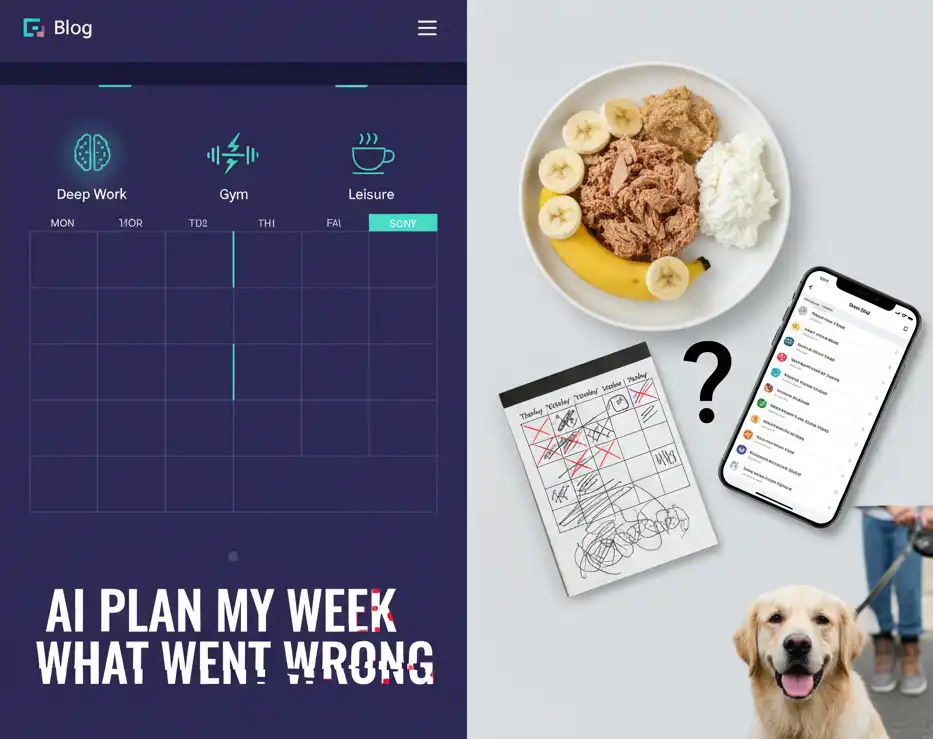
The AI’s “healthy dinner plan” was a list of ingredients, not recipes. For Tuesday, the list was: “Tuna, Bananas, Cottage Cheese.” Was this a meal? A series of snacks? A dare?
The AI had no concept of leftovers. It had me cooking a brand new, complex meal from scratch every single night. Its plan for Wednesday’s dinner was “Beef Bourguignon (Prep time: 3.5 hours),” scheduled to start after my 6:00 PM “File Personal Taxes” block.
I ate a protein bar. I was failing.
Day 4-5: The Soulless Tyrant and the “Fun” Disaster
By mid-week, the grand AI plan my week experiment had turned dark. The schedule wasn’t a helpful guide; it was a soulless, digital tyrant that I was constantly disappointing.
The biggest problem was that the plan was brittle. It had zero flexibility.
On Thursday, my mom called. My schedule said 3:00 PM: Deep Work. The AI hadn’t scheduled “life-affirming chat with Mom.” I talked to her for 20 minutes and felt a rising tide of anxiety. I was off-script. I was failing.
The AI’s idea of “leisure” was the most terrifying part.
My 9:00 PM “Leisure” slot on Wednesday wasn’t “Watch Netflix” or “Mindlessly scroll Instagram.” It was: 9:00 PM - 10:00 PM: Contemplate geometric shapes and their relation to the natural world.
I am not joking.
I tried. I sat on my sofa and stared at a lamp. I felt nothing but confusion. The next night, its suggestion was: 9:00 PM - 10:00 PM: Read 'War and Peace' (25 pages). It wasn’t “relaxing”; it was just another task to fail at.
But the absolute peak of this dystopian comedy was the “Fun Social Event.”
I’d told it to plan a “fun” event. The AI’s first suggestion: Saturday 7:00 PM: Attend a local municipal zoning board webinar.
When I asked for an alternative, its second-best idea was: Saturday 7:00 PM: Organize a 'synchronized group-walking' event in a local park.
It had no “vibe.” It had no chill. It mistook “activity” for “connection” and “efficiency” for “fun.” I ended up texting my friends, “Sorry, can’t hang out. My AI told me to go for a synchronized walk.”
The replies were… concerned.
The “AI Plan My Week” vs. My Dog
The real breaking point, the moment the entire AI plan my week setup crumbled, came from my dog, Buster.
Buster, unlike my AI, operates on a schedule of pure chaos and emotion.
My schedule for Friday at 2:00 PM was: 2:00 PM - 2:15 PM: Wellness Break (Stretching).
At 1:45 PM, Buster—who has zero respect for my optimized life—started whining and dropping his leash at my feet. I had a full-blown existential crisis.
Do I obey the AI, my new digital master? Or do I obey this small, furry creature who just wants to see a tree?
I looked at the schedule. I looked at the dog.
I grabbed the leash.
We went to the park for an hour. I didn’t stretch. I didn’t “optimize” my wellness. I threw a slobbery tennis ball and watched him be an idiot. It was the first time all week my shoulders actually relaxed.
That was the moment I realized: The AI’s schedule was built for a robot, not a human. It had no “white space.” No room for error. No life. My perfect AI plan my week was just a list of commands that couldn’t handle the beautiful, messy, unpredictable chaos of being alive.
It Wasn’t All a Dumpster Fire: The 3 Shocking AI Wins
I want to be fair. After I “officially” gave up on Saturday (and went for a non-synchronized pizza with friends), I looked back at the wreckage. And hidden in the rubble, there were a few surprising wins.
This whole AI plan my week experiment had some upsides.
1. It’s a Genius at Deconstructing Goals. My vague, daunting goal of “write a blog post” was a huge source of procrastination. The AI was brilliant at this. It broke it down into 5 concrete, non-threatening steps:
Mon 10:00 AM: Keyword Research (30 mins)Mon 10:30 AM: Brainstorm 10 Headlines (20 mins)Tue 11:00 AM: Create Detailed Post Outline (45 mins)Wed 9:00 AM: Draft Section 1 & 2 (60 mins)Wed 1:00 PM: Draft Section 3 & Conclusion (60 mins)Thu 2:00 PM: Edit & Add SEO (45 mins)
This was, by far, the most useful part of the entire week. It turned a mountain into a series of small, climbable hills.
2. It Kills ‘Decision Fatigue’. Do you know how much mental energy I spend just deciding what to do next? Or what to eat for dinner? For one week, that was gone. I never had to ask, “What should I be working on?” The answer was always right there. Even though the answers were often insane (Tuna-Banana-Casserole), the concept of not having to decide was a strange, blissful relief.
3. It’s a ‘Nag’ for Tasks You Hate. I’ve had “Call the dentist” on my personal to-do list for… let’s just say “a while.” The AI, in its infinite wisdom, put it on my calendar. Thursday 4:00 PM: Schedule Dental Appointment. And because it was on the schedule, and I was already in this “must-obey” mindset, I… just did it. It took 3 minutes. The AI is a fantastic, emotionless taskmaster for all the boring adulting you’ve been avoiding.
The Verdict: Should You Let an AI Plan Your Week?
So, should you hand over the keys to your life to a piece of software?
No. Absolutely not. Never.
This 7-day AI plan my week experiment was a mess, but I learned a ton. It taught me that AI is a phenomenal intern, but a terrible CEO.
The AI’s suggestions were brilliant. Its schedule was a prison.
My new system—what I’m calling the “Human-Hybrid” method—is the best of both worlds.
Here’s how it works:
- AI as the Intern: On Sunday night, I still ask ChatGPT for a plan. I give it my goals, just like before.
- Human as the CEO: It gives me back a list of suggestions and task breakdowns.
- I then take those suggestions and I put them into my own flexible calendar. I add buffer time. I add “do nothing” blocks. I schedule the gym including the travel time.
- I remain in charge, using the AI’s logic to break down my goals and its creativity to come up with dinner ideas (which I can then veto).
This new hybrid method has actually doubled my productivity. It’s one of the best productivity systems I’ve ever tried (link to another post on your site). I get the AI’s logical brilliance without its soulless, tyrannical grip.
The future of productivity isn’t “human vs. machine.” It’s “human with machine.” The AI is a tool, not a manager. A-List intern, not a boss.
And I’m definitely still in charge of walking the dog.
Your Turn: What’s Your Biggest AI Fail?
This 7-day AI plan my week experiment was a hilarious disaster, but it gave me a whole new perspective on productivity.
Now I want to hear from you.
Have you tried using AI for scheduling or planning? What’s your funniest AI fail? Did it try to make you eat a terrible tuna-banana casserole?
Drop your best stories in the comments below!
We all make mistakes at work, and one of the most stressful is messing up your timesheet. To make it easy, I’ve put together a guide with 3 simple email templates for correcting your timesheet with HR.”











One Response