
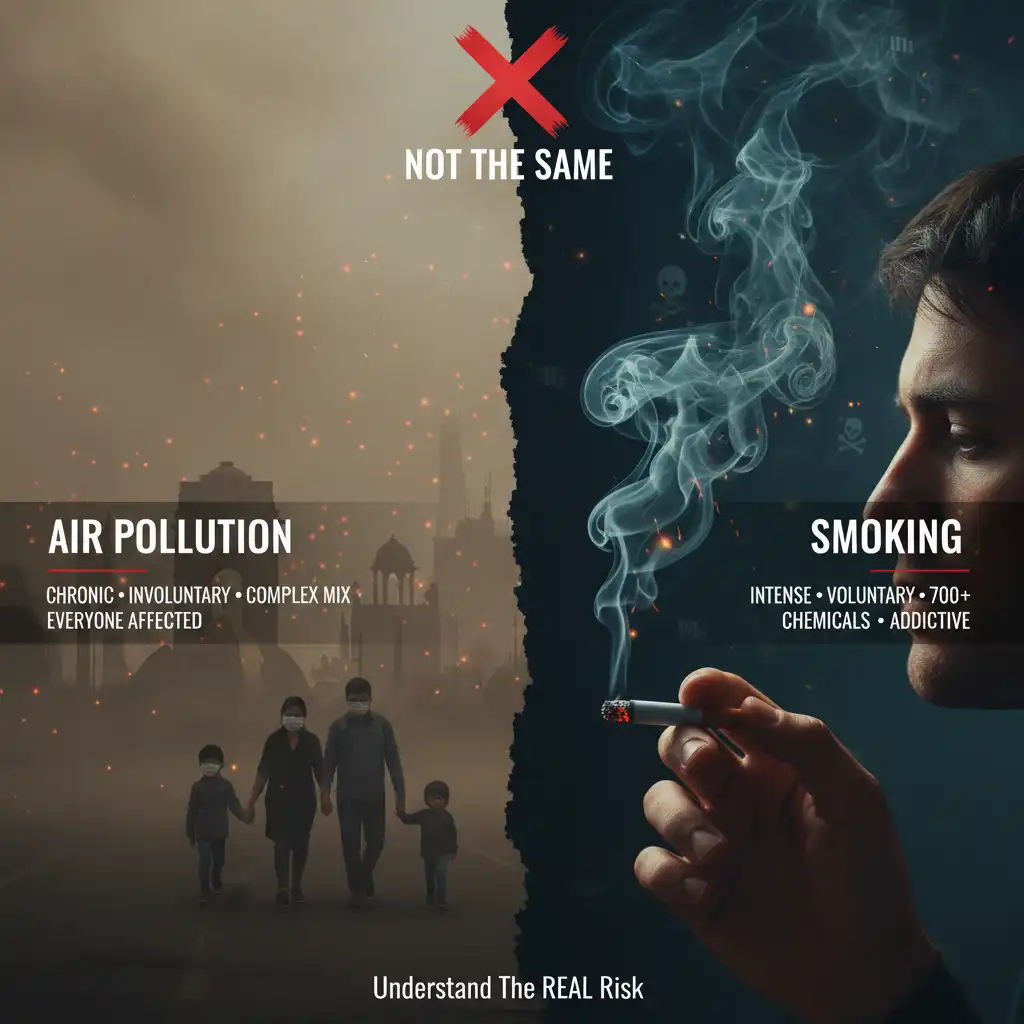
You’ve seen the terrifying headlines every winter. As a thick, grey haze blankets the skyline, a news report flashes: “Breathing Air in Delhi is Like Smoking 20 Cigarettes a Day!”
This powerful claim, the air pollution comparison to smoking, has become a global shorthand for “the air is really, really bad.” It’s a visceral, frightening image that immediately grabs your attention. It’s designed to make the invisible, odorless threat of air pollution feel as tangible and deadly as a pack-a-day habit.
But is it true? Is your daily commute or a morning walk in the park scientifically equivalent to deliberately inhaling tobacco smoke?
The short answer is a definitive no.
While both air pollution and smoking are catastrophic for human health, this popular analogy is a dangerous oversimplification. It’s a well-intentioned metaphor that has run amok, creating a fog of misinformation that is scientifically flawed, misleading, and potentially harmful in its own right.
This article will dismantle the air pollution comparison to smoking, exploring its origins, its seven critical flaws, and the real-world harm this myth can cause. More importantly, we’ll explain the metrics that actually matter—like PM2.5 and AQI—so you can understand your real risk, not just the scary headline.
1. The Origin: Where Did This “Cigarette Equivalence” Come From?
This comparison wasn’t just invented by a journalist. It was popularized by researchers at Berkeley Earth in 2015. They wanted to create a simple “rule of thumb” to help people grasp the scale of the pollution problem.
Their calculation was straightforward: they estimated that the health risk from breathing 22 micrograms per cubic meter (µg/m³) of PM2.5 (a tiny, dangerous pollutant) for 24 hours was roughly equivalent to the health risk of smoking one cigarette.
It’s simple, terrifying math.
Let’s apply this to Delhi. On a “severe” day, the PM2.5 levels can easily soar past 440 µg/m³.
- The Math: 440 (Delhi’s PM2.5) / 22 (the “one cigarette” number) = 20.
- The Headline: “Breathing Delhi Air is Like Smoking 20 Cigarettes!”
This “cigarette equivalent” was a brilliant communication tool. It instantly translated a confusing scientific number (µg/m³) into an image everyone understands. It gave the invisible killer a familiar, villainous face.
The problem is, the real world is far more complex than this simple equation.
2. Debunked Fact 1: A Cigarette is a Targeted Chemical Weapon
The most significant flaw in the air pollution comparison to smoking is the chemistry. Comparing the two is like comparing a general industrial waste pile to a targeted-delivery chemical weapon.
Air pollution is a complex soup of harmful substances. Its main components include:
- Particulate Matter (PM2.5 and PM10)
- Nitrogen Oxides (NOx)
- Sulfur Dioxide (SO2)
- Carbon Monoxide (CO)
- Ozone (O3)
Cigarette smoke contains all of these plus a proprietary, super-heated blend of over 7,000 other chemicals, including at least 69 known carcinogens.
Here’s a simple breakdown of what’s in each.
| Pollutant / Chemical | Found in Ambient Air Pollution? | Found in Cigarette Smoke? |
| PM2.5 | Yes (Primary concern) | Yes (In extreme concentrations) |
| Nitrogen Oxides | Yes | Yes |
| Carbon Monoxide | Yes | Yes |
| Benzene | Yes (in small amounts) | Yes (In high, carcinogenic levels) |
| Formaldehyde | Yes (in small amounts) | Yes (In high, carcinogenic levels) |
| Tar | No | Yes (A major component) |
| Nicotine | No | Yes (The addictive agent) |
| Known Carcinogens | Some | At least 69+ |
A single cigarette is a “carefully engineered nicotine-delivery device” that also happens to deliver an unparalleled concentration of cancer-causing chemicals directly into your lung tissue. The air, even on Delhi’s worst day, is not.
3. Debunked Fact 2: A Hot, Direct Hit vs. a Cold, Ambient Soak
The second flaw in the air pollution comparison to smoking is the delivery method.
- Smoking: This is an active process. A smoker takes a deliberate, deep pull of hot, unfiltered, and ridiculously concentrated smoke. A single puff can generate particulate matter concentrations in the thousands or even tens of thousands of µg/m³. This toxic blast hits the delicate lung tissue (the alveoli) at high velocity and high temperature, causing immediate, targeted inflammation and damage.
- Breathing Polluted Air: This is a passive and ambient process. The pollutants are mixed into the air you breathe over 24 hours. The concentration, even on that 440 µg/m³ day in Delhi, is a tiny fraction of what’s inside a single cigarette puff.
Think of it this way: The “cigarette equivalent” is based on the total dose over a day. But the way that dose is delivered matters immensely.
A single, intense punch to the face (smoking) is not the same as being lightly pushed 100 times throughout the day (pollution). Both are harmful, but they are not the same experience and cause different kinds of trauma.
4. Debunked Fact 3: The Nicotine Factor: Addiction vs. Necessity
This is a critical, non-negotiable difference that the air pollution comparison to smoking completely ignores.
- Smoking is a behavior, a choice that is heavily driven by a powerful chemical addiction to nicotine.
- Breathing is a biological necessity. You cannot opt out of it.
You can’t tell a non-smoker in Delhi to “just quit breathing.” They are a passive victim of their environment. This distinction is crucial because it changes the solution.
The solution to smoking is behavioral and medical (addiction treatment, quitting aids). The solution to air pollution is systemic, political, and technological (clean energy, industrial regulation, better public transport).
Lumping them together confuses the public and misdirects our energy.
5. Debunked Fact 4: The Public Health Danger of the Myth
Public health officials and anti-tobacco advocates hate this analogy. Why? Because it’s actively harmful.
The air pollution comparison to smoking creates a sense of fatalism and “risk normalization.”
- It Trivializes Smoking: The analogy provides a smoker with a perfect excuse. “Why should I bother quitting? The air I breathe in Delhi is just as bad as my 20-cigarette habit anyway.” It makes the extreme, self-inflicted danger of smoking seem mundane.
- It Creates Fatalism: For the non-smoker, the message is, “You’re getting lung cancer anyway, so what’s the point?” This sense of helplessness can lead people to stop taking any protective measures, like wearing N95 masks or using air purifiers.
The truth is, smoking is far more dangerous on an individual level. An average smoker loses about 10 years of life expectancy. While pollution is a massive global problem, it does not carry the same per-person risk as a long-term smoking habit.
6. Debunked Fact 5: Different Risks for Different People
The air pollution comparison to smoking assumes a “one-size-fits-all” victim. This is completely false.
- Air Pollution: The risk is not distributed equally. It is exponentially more dangerous for the most vulnerable:
- Children (their lungs are still developing).
- The elderly.
- Pregnant women.
- People with pre-existing conditions (asthma, COPD, heart disease).
- Smoking: While smoking also harms others via secondhand smoke, the primary, overwhelming risk is concentrated in the individual who chooses to smoke.
The Berkeley Earth calculation was based on an “average” adult. But pollution’s true toll is measured in the hospital visits of asthmatic children and the premature deaths of the elderly—groups for whom the “cigarette” analogy is both meaningless and insulting.
Forget Cigarettes: Understanding the Metrics That Actually Matter (PM2.5 vs. AQI)
So, if the air pollution comparison to smoking is a myth, what should we be paying attention to? The answer lies in two numbers you see on your weather app: PM2.5 and AQI.
They are not the same thing, and understanding the difference is key to protecting yourself.
What is PM2.5?
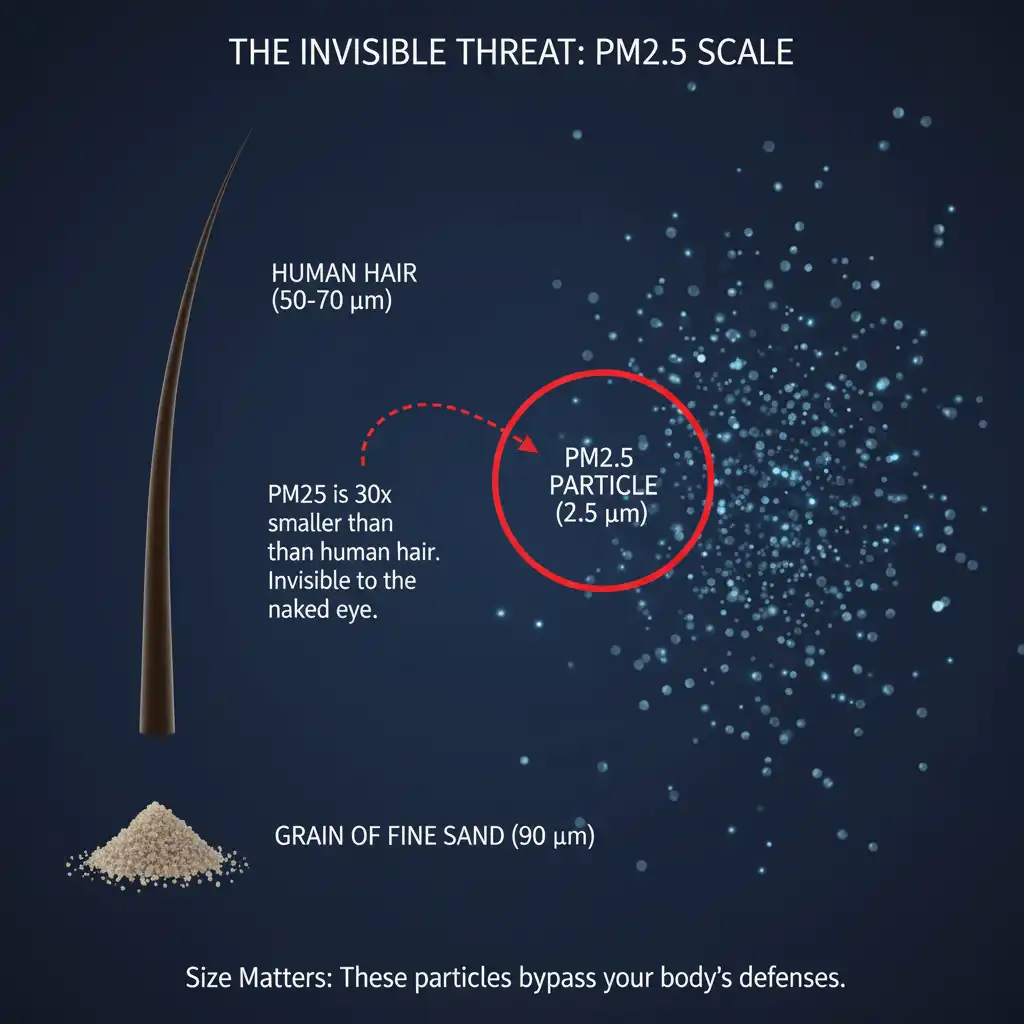
PM2.5 stands for Particulate Matter that is 2.5 micrometers or less in diameter.
To put that in perspective, a single human hair is about 70 micrometers wide. A PM2.5 particle is about 1/30th the width of a human hair.
These particles are the real villains of air pollution. They are so small that when you breathe them in, they don’t just stay in your lungs. They can bypass your body’s natural defenses, enter your bloodstream, and travel to every organ, including your heart and brain.
They are made of a mix of “soot” (black carbon), chemicals, acids, and metals. This is the specific pollutant that causes the most long-term health damage, like heart attacks, strokes, and lung cancer.
When you see a number like “150 µg/m³” for PM2.5, that is a direct measurement of the concentration of this one specific, deadly pollutant in the air.
What is AQI (Air Quality Index)?
The AQI (Air Quality Index) is not a direct measurement of a single pollutant. It is an index—a “thermometer” for your air quality.
Think of it this way: Your body temperature is 98.6°F. This is a direct measurement, like PM2.5. A “fever” is a warning category, like the AQI.
The AQI takes the measurements of multiple pollutants (usually PM2.5, PM10, Ozone, CO, and SO2), weighs them based on their health risk, and bundles them into a single, color-coded number from 0 to 500.
This is what those numbers and colors mean:
- 0-50 (Green): Good.
- 51-100 (Yellow): Moderate.
- 101-150 (Orange): Unhealthy for Sensitive Groups.
- 151-200 (Red): Unhealthy for all.
- 201-300 (Purple): Very Unhealthy.
- 301-500+ (Maroon): Hazardous.
Key Differences: PM2.5 vs. AQI (Table)
| Feature | PM2.5 | AQI (Air Quality Index) |
| What it is | A specific, physical pollutant (fine dust). | A composite score or index (like a grade). |
| What it measures | The concentration of one pollutant (in µg/m³). | The overall health risk from multiple pollutants (a number). |
| Analogy | The amount of rain that fell (e.g., 2 inches). | The weather warning (e.g., Flood Watch, Severe Storm). |
| Main Purpose | Scientific measurement and analysis. | Simple public health communication. |
When the AQI in Delhi hits 450 (Maroon), it’s the PM2.5 particles that are almost always the main driver. The AQI is just the easiest way to tell you: “It’s extremely dangerous to be outside.”
7. The Shared Dangers: What Both Actually Do to Your Body
While the air pollution comparison to smoking is inaccurate, the outcomes are terrifyingly similar. This is the most crucial takeaway.
You don’t need a flawed metaphor to understand the danger. The World Health Organization (WHO) has classified outdoor air pollution as a Group 1 Carcinogen—the same category as tobacco smoke, asbestos, and radiation.
Both long-term smoking and chronic exposure to high PM2.5 levels are scientifically linked to a devastating list of the same diseases:
- Lung Cancer
- Heart Attacks and Cardiovascular Disease
- Strokes
- COPD (Chronic Obstructive Pulmonary Disease)
- Emphysema
- Asthma aggravation
- Premature birth and low birth weight
Air pollution is a slow, invisible, and unavoidable assailant. Smoking is a fast, visible, and (initially) voluntary one. They are different weapons, but they can lead to the same tragic end.
Moving Beyond the Myth: What You Can Actually Do
The air pollution comparison to smoking is a dead end. It offers no solution, only fear.
The reality is that you live in Delhi, and the air is a real health threat. So, what’s the practical, non-alarmist solution?
- Stop Using the Analogy: First, stop repeating the myth. When you hear it, explain that the reality is more complex and that the real danger (PM2.5) is bad enough on its own.
- Monitor the Real Data: Don’t worry about “cigarettes.” Download an app that shows you the live AQI and PM2.5 levels for your specific neighborhood. Check it just as you would check the weather.
- Take Internal Action: On high AQI days (Red, Purple, or Maroon), the solution is simple: seal your indoors.
- Air Purifiers: This is the single most important investment you can make for your health in a polluted city. Run a HEPA filter purifier in your bedroom and main living area. (Find the right one for you in our guide: The Best Air Purifiers for Delhi Homes 2026).
- Close Windows: Keep windows and doors shut on bad air days.
- Protect Yourself Outside:
- Wear the Right Mask: A simple cloth mask or surgical mask does nothing against PM2.5. You need a well-fitting N95 or FFP2 mask. (Read more: N95 vs. Cloth Masks: Why One is Useless Against Pollution).
- Limit Exercise: Avoid strenuous outdoor exercise when the AQI is high. Heavy breathing pulls more of those tiny particles deep into your lungs.
The Final Word
The air pollution comparison to smoking was a tool for grabbing attention. But now that we are paying attention, it’s time to discard it for the blunt, inaccurate instrument it is.
The danger from air pollution isn’t a metaphor. It’s a measurable, scientific reality backed by data. It’s measured in PM2.5, not cigarettes.
Let’s stop trying to scare people with a flawed analogy and start empowering them with the facts. Check your AQI, invest in a purifier, wear the right mask, and demand cleaner energy policies. That is how you fight back—not by counting imaginary cigarettes.
It’s also helpful to re-frame the danger in its proper context. Smoking is unequivocally the most intense, voluntary health risk an individual can take. Air pollution, by contrast, is the largest involuntary environmental risk to all of public health. The danger of pollution is not its intensity for one person, but its unavoidability; it affects everyone, from a newborn baby to an elderly person, without their consent.
The air pollution comparison to smoking also dangerously shifts the burden of responsibility. It subtly frames a systemic, industrial, and political failure as if it were a personal lifestyle choice. This flawed logic can delay the collective action and policy changes we desperately need, letting the real polluters off the hook while we argue over metaphors.
Ultimately, understanding the real science is far more empowering than repeating a scary myth. Focusing on the actual PM2.5 and AQI numbers gives you the power to take practical, defensive action. It allows you to protect your family’s health on bad air days and, more importantly, equips you with the right facts to demand long-term, systemic change from your community leaders.
You Might Also Like…
Best Pre-Workout Supplements Without Caffeine: Our 5 Essential Picks for 2026












One Response