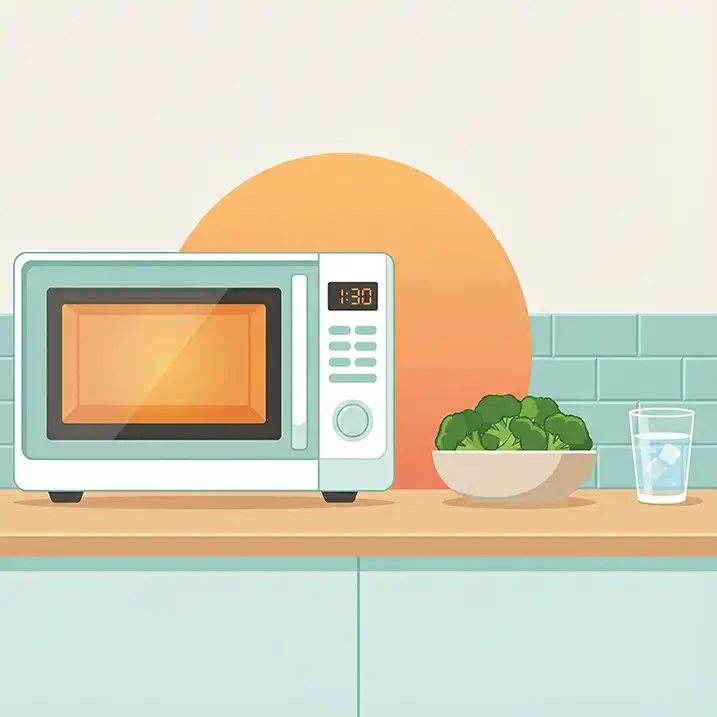
You are standing in your kitchen, staring at the spinning plate inside the microwave. The timer counts down, and a thought creeps into your mind. You have heard the rumors for years. Your aunt mentioned it on Facebook, and you saw a headline about it once. You start to wonder: does microwave food cause cancer?
It is a question that has plagued home cooks since the “radar range” first entered domestic life in the 1970s. The idea that a box sitting on your counter is zapping your dinner with radiation sounds terrifying. We associate radiation with nuclear disasters and X-rays, not reheating yesterday’s lasagna.
However, fear often stems from a lack of understanding. To make the best health decisions for you and your family, you need facts, not fear-mongering. In this extensive guide, we are going to strip away the pseudoscientific noise. We will look at how microwaves actually work, what the world’s leading health organizations say, and where the real dangers in your kitchen might actually be hiding.
Let’s settle this once and for all.
The Science of Heat: How Microwaves Actually Work
To understand if does microwave food cause cancer, we first need to understand the machine itself. It is not a miniature nuclear reactor. It is simply a tool that manipulates energy.
Microwaves are a form of electromagnetic radiation. Before you panic at the word “radiation,” remember that visible light—the stuff coming from your lightbulbs and the sun—is also electromagnetic radiation.
The Magic of Water Molecules
Microwave ovens use a component called a magnetron. This tube converts electricity into low-frequency radio waves. These waves bounce around the metal interior of your oven until they hit your food.
Here is the cool part: these waves specifically target water molecules. Water molecules are dipoles, meaning they have a positive end and a negative end. When the microwave energy hits them, they start to vibrate rapidly to align with the changing electromagnetic field.
This vibration creates friction. As we learned in high school physics, friction creates heat. That is why your soup gets hot, but the microwave plate (which has no water) stays relatively cool until the bowl warms it up. This is a mechanical heating process, not a chemical change.
Ionizing vs. Non-Ionizing Radiation
This is the most critical distinction in the entire debate surrounding the question: does microwave food cause cancer?
There are two types of radiation:
- Ionizing Radiation: This includes X-rays, gamma rays, and ultraviolet (UV) light. This type possesses enough energy to remove electrons from atoms. It can damage DNA and cells, which can indeed lead to cancer.
- Non-Ionizing Radiation: This includes radio waves, microwaves, and visible light. These do not have enough energy to knock electrons off atoms or damage DNA directly. They can only move atoms around, which causes heat.
Microwaves fall strictly into the non-ionizing category. According to the American Cancer Society, microwave ovens do not make food radioactive. When you turn the microwave off, the waves disappear instantly, just like the light goes out when you flip a switch.
Does Microwave Food Cause Cancer? Analyzing the Radiation Myth
Despite the physics, the myth persists. Why? Because the word “radiation” carries a heavy stigma. When people ask, “does microwave food cause cancer?“, they are often conflating high-energy nuclear radiation with low-energy radio waves.
The Safety Standards
Since 1971, microwave ovens have been strictly regulated. In the United States, the FDA enforces limits on the amount of microwave energy that can leak from an oven throughout its lifetime. This limit is set far below the level known to harm people.
A microwave oven with a damaged door or a broken latch could theoretically leak waves. However, even if you were standing directly in front of a leaking microwave, the energy drops off dramatically with distance.
To sustain any injury, you would need to be exposed to massive amounts of this energy for a long time, which would result in a thermal burn (like touching a hot stove), not radiation poisoning or DNA mutation.
No Residual Radiation
A common misconception is that the food itself becomes radioactive. This is scientifically impossible with microwave energy.
Think of it like sunlight. If you stand in the sun, you get warm. When you step into the shade, you stop getting warm. You do not continue to glow or emit sunlight. Similarly, once the microwave beeps, the energy transfer stops. Your food is hot, but it is not “contaminated” with waves.
Nutrient Loss: Is The Microwave Killing Your Vitamins?
If the answer to “does microwave food cause cancer?” is a resounding no, what about nutrition? Many health enthusiasts worry that “nuking” food destroys its nutritional value.
The truth might surprise you. In many cases, microwaving is actually better for nutrient retention than other cooking methods.
The Enemies of Nutrients
Three things generally destroy nutrients, particularly Vitamin C and B vitamins:
- Heat.
- Water (leaching).
- Time.
Comparison with Boiling
Let’s look at boiling vegetables. When you boil broccoli, you submerge it in a large amount of hot water for a long time. The water-soluble vitamins leach out into the water, which you then pour down the drain.
Microwaving, on the other hand, uses very little water and cooks food very quickly.
A study published by Harvard Health Publishing confirms that because microwaving takes less time and uses less liquid, it does a better job of preserving the nutrient content of fruits and vegetables than boiling.
The Broccoli Experiment
Research has specifically looked at broccoli. While some older studies suggested high nutrient loss, modern food science indicates that steaming broccoli in the microwave (with just a teaspoon of water) retains more glucosinolates (cancer-fighting compounds) than boiling it.
So, ironically, if you are worried about cancer prevention, microwaving your veggies might be smarter than boiling them to death on the stove.
The Real Danger: Plastic Containers
When people ask “does microwave food cause cancer?“, they are looking at the oven. They should be looking at the container.
This is where the real health risk lies. The microwave process itself is safe, but the vessel you cook in matters immensely.
BPA and Phthalates
Many older plastic containers contain Bisphenol A (BPA) and phthalates. These are chemicals used to make plastics durable and flexible.
These chemicals are known as endocrine disruptors. They can mimic human hormones like estrogen. When plastic is heated, these chemicals can leach out of the container and into your food.
There is legitimate scientific concern linking these chemicals to various health issues, including reproductive problems and, potentially, increased risks of certain hormone-related cancers.
The “Microwave Safe” Label
You must only use containers labeled “Microwave Safe.” The FDA requires that plastics meant for use in food packaging must be tested.
However, many experts recommend skipping plastic entirely. Even “BPA-Free” plastics often use replacement chemicals (like BPS) that may have similar effects.
Actionable Tip: To ensure safety, always transfer your food to a glass or ceramic bowl before heating. Glass is inert. It does not react with heat, and it will not leach chemicals into your meal. This simple switch eliminates the primary chemical risk associated with microwave cooking.
Does Microwave Food Cause Cancer via Chemical Changes?
Another branch of the myth suggests that the rapid heating of the microwave changes the chemical structure of the food, creating new, carcinogenic compounds.
The acrylamide Question
High-temperature cooking of starchy foods (like potatoes) can create a chemical called acrylamide. This happens in frying, roasting, and baking. It is a natural byproduct of the Maillard reaction (browning).
Acrylamide has been linked to cancer in animal studies. However, because microwaves cook food at lower temperatures compared to frying and often boil food from the inside out (via water molecules), they generally produce less acrylamide than frying or baking.
For example, microwaving a potato is healthier than turning it into french fries. The method of cooking is safer regarding carcinogen formation, not more dangerous.
The “Blood Chemistry” Hoax
There is a famous, often-cited “study” from 1989 claiming that microwaved milk changed the blood chemistry of participants. It is important to know that this was not a peer-reviewed study. It involved a tiny sample size and has been thoroughly debunked by the scientific community.
No reputable, large-scale study has ever found that eating microwaved food changes human blood chemistry or immune function.
Addressing the “Uneven Cooking” Risk
While we have established that the answer to “does microwave food cause cancer” is no, microwaves do have a safety flaw: uneven heating.
Microwaves penetrate food unevenly. This can leave “cold spots” where bacteria can survive. If you are reheating leftovers or cooking raw meat, this is a genuine concern.
Salmonella and E. Coli
If a microwave does not heat food thoroughly, harmful bacteria like Salmonella might not be killed. This isn’t cancer, but food poisoning is a serious health risk.
How to fix this:
- Always stir your food halfway through the heating cycle.
- Use the turntable.
- Let the food stand for 1-2 minutes after the timer goes off. This allows the heat to distribute evenly throughout the dish (conduction).
Common Myths vs. Facts Table
To make this easier to digest, let’s break down the common fears surrounding the question “does microwave food cause cancer?” into a simple fact sheet.
| The Myth | The Fact |
| Microwaves make food radioactive. | False. Microwaves use non-ionizing radiation. They heat food, they don’t contaminate it. |
| Microwaves destroy all nutrients. | False. Due to short cooking times, they often preserve more nutrients than boiling. |
| Looking at the microwave gives you cataracts. | Unlikely. Modern regulation ensures shielding meshes prevent leakage. Just don’t press your face against the glass for hours. |
| Microwaving plastics causes cancer. | Plausible. Heating non-microwave-safe plastics can leach harmful chemicals. Use glass instead. |
Why The Myth Persists in Natural Health Circles
If the science is so clear, why do we still ask, “does microwave food cause cancer?“
It often comes down to the “Naturalistic Fallacy”—the belief that anything natural is good, and anything technological or man-made is bad. Fire is “natural.” Microwaves seem “artificial.”
However, wood smoke from a “natural” fire contains tars and carbon monoxide, which are definitely carcinogenic. Just because a cooking method is high-tech doesn’t make it harmful. In fact, by eliminating the need for added oils and chars (which happens in grilling), microwaving is one of the “cleanest” ways to prepare a meal.
[Internal Link: Read more about Healthy Kitchen Habits here] – Note: This links to your informational blog category on general wellness.
5 Rules for Safe Microwave Use
You can stop worrying about the radiation and start focusing on best practices. Here is how to use your appliance safely and effectively.
1. Ditch the Takeout Containers
Never reheat food in the styrofoam or plastic tubs it was delivered in. These are often designed for single-use cold storage, not high heat. They can warp and melt, releasing chemicals into your curry or pasta.
2. Check the Door
Make sure the door seal of your microwave is intact. If the door is cracked, bent, or doesn’t close firmly, it is time to buy a new one. While leakage is rare, physical damage to the unit is the only way it typically happens.
3. Don’t Superheat Water
This is a rare but real physical danger. If you heat clean water in a smooth cup for too long, it can “superheat” past the boiling point without bubbling. When you move the cup or drop a tea bag in, it can violently erupt, causing severe burns. Always put a wooden spoon or a non-metal object in the water if you are boiling it in the microwave.
4. Cover Your Food
Use a glass lid or a microwave-safe splatter guard. This keeps the moisture in (steaming the food) and keeps your microwave clean. A clean microwave is more efficient and sanitary.
5. Rotate and Stir
We mentioned this before, but it bears repeating. To avoid food poisoning, ensure the heat reaches every part of the meal.
Conclusion: The Final Verdict
So, does microwave food cause cancer?
The answer from the scientific community, the World Health Organization, and cancer research institutes globally is a definitive No.
Microwaves use safe, non-ionizing radiation to vibrate water molecules. They do not damage DNA. They do not make your food radioactive. In many instances, they preserve the vitamins in your vegetables better than a pot of boiling water ever could.
The anxiety surrounding microwaves is a relic of the past, a misunderstanding of how physics works. The only thing you truly need to worry about is the container you use. By switching to glass or ceramic and ditching the plastic, you eliminate the chemical risks.
Technology in the kitchen is there to help us. It saves time, energy, and yes—even nutrients. So tonight, when you need to reheat that soup or steam some broccoli, go ahead and press the start button. Your dinner will be hot, healthy, and safe.
External References for Further Reading
- World Health Organization (WHO) – Electromagnetic fields & public health
- American Cancer Society – Microwaves, Radio Waves, and Other Types of Radiofrequency Radiation
- Harvard Health – Microwave cooking and nutrition
You Might Like this:
Ashwagandha vs. L-Theanine: The Ultimate 2026 Guide to Beating Stress