
Living in a small apartment is a reality for many of us. You get a great location, a (somewhat) reasonable rent, and in exchange, your living room also serves as your dining room, home office, and gym.
It’s easy to feel like you’re living in a “shoebox.” The walls feel like they’re closing in, and no amount of tidying can fix the fundamental lack of space.
But what if I told you it’s all an illusion?
Your apartment isn’t too small. It’s just being styled wrong. The feeling of “space” is a game of light, lines, and perception. It’s an optical illusion you can create.
You don’t need a demolition crew or a winning lottery ticket. You just need a weekend, a $100 bill, and a plan. This isn’t just a list of tips; this is your battle plan. We are going to trick the human eye and make your small apartment look twice as big—all for under $100.
Principle #1: The Light Deception (Your $40 Power Play)
If your apartment feels like a cave, the first thing we need to do is add light. Light is the single most powerful tool for making a space feel open, airy, and expensive. Cluttered, dark corners are what make a room feel small. Our goal is to eliminate them.
The Magic of Mirrors: The Oldest Trick in the Book
This is the classic, non-negotiable hack to make your small apartment look twice as big. Why? Because mirrors do two things: they reflect light (making the room brighter) and they reflect the view (creating the illusion of depth).
Your brain sees the reflection and perceives it as an extension of the room—like a window or a doorway to another room.
You’re not just hanging a mirror to check your outfit. You’re hanging it to build a new window.
- The Big Mistake: Many people buy one small, decorative mirror. This is a mistake. For this hack, you need to go big. We’re not “decorating”; we’re “expanding.”
- The $40 Budget Hack: Forget expensive, heavy, framed mirrors. Go to any big-box store (or Amazon) and buy a pack of frameless peel-and-stick mirror tiles. You can get a set of 8-12 tiles for under $40.
- How to Use Them:
- Behind a Lamp: Place a lamp on a side table. Install a mirror tile (or a small, cheap standing mirror) on the wall directly behind it. You just doubled the amount of light from that one source.
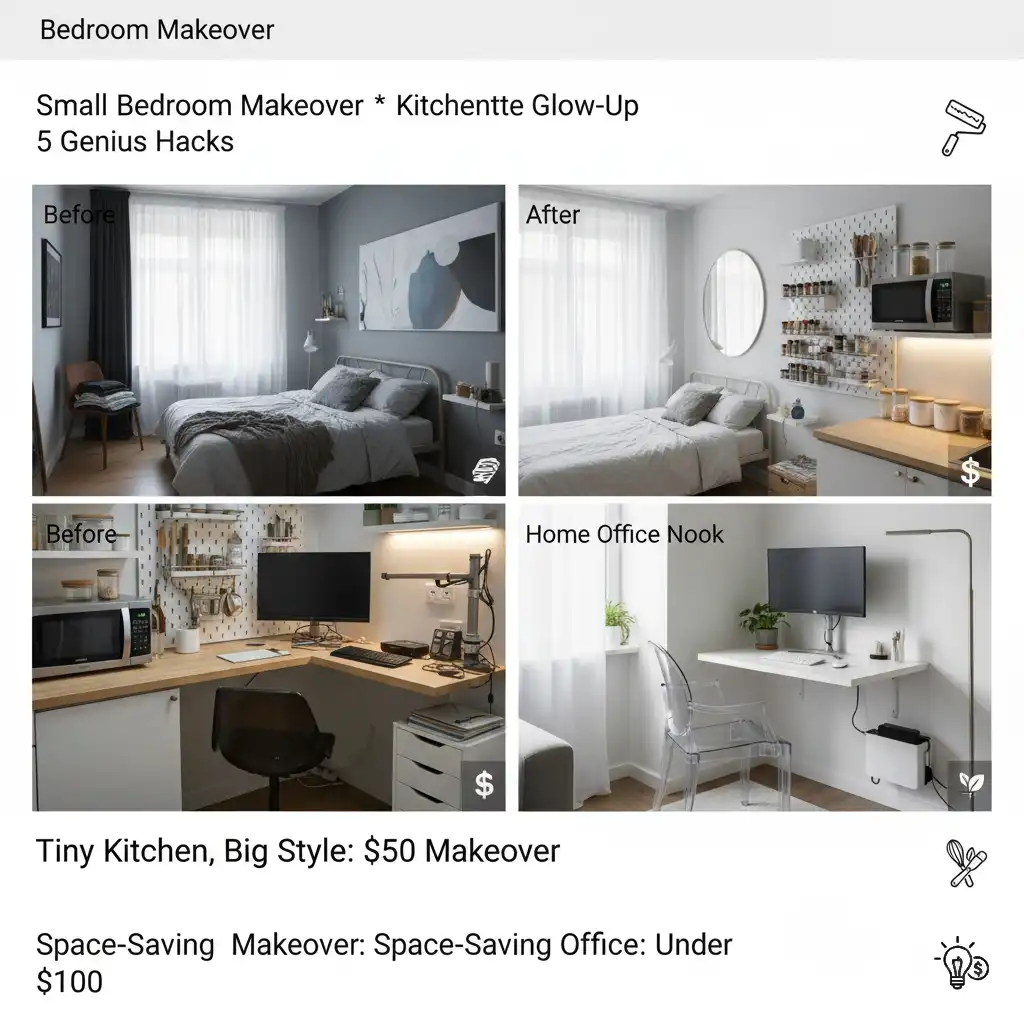
- The “Fake Window”: Find the wall opposite your main window. This is your prime real estate. Hang a large mirror or create a grid of your mirror tiles here. It will catch all the natural light and blast it back into the room.
- On a Closet Door: Closet doors are dead, boring space. Cover a bifold closet door with mirror tiles. It will make your whole bedroom feel larger and brighter, and it doubles as a full-length mirror.
Wash Your (Free) Windows
This is your $0 hack, and it’s shockingly effective. Your windows are the primary source of the light we’re trying to maximize. Over time, they accumulate a layer of dust and grime that literally dims your apartment.
Cleaning them, inside and out, can increase the amount of natural light by 10-20%. It’s like upgrading your lightbulbs for free. This simple act alone will make the entire space feel more open and alive.
Principle #2: The Vertical Illusion (Your $30 Masterstroke)
The second biggest mistake people make in small spaces is only thinking about floor space. You’re paying rent for the full volume of your apartment, so it’s time to use the vertical real estate.
Our goal here is to draw the human eye upward. When you force someone to lift their gaze, it creates the illusion of height and grandeur. We want to create long, unbroken vertical lines that make the ceiling feel taller than it really is.
How to Make Your Small Apartment Look Taller with Curtains
This is my single favorite hack to make your small apartment look twice as big, and it costs about $30.
- The Big Mistake: Most people buy a curtain rod that’s the exact width of the window. Then they hang it right on top of the window frame. This “boxes in” the window and makes it look small and poky.
- The $30 Fix:
- Go High: Take your curtain rod (a basic one costs $10-$15) and mount it as high as you possibly can. I mean high. Just a few inches below the ceiling line is perfect.
- Go Wide: Your rod should extend at least 4-6 inches past the window frame on either side. This makes the window itself look wider and more impressive.
- Go Long: Now, buy curtains (your other $15-$20) that are long enough to go from that high-up rod and just kiss the floor. No “high-water” curtains that stop at the windowsill. We need a full, unbroken line.
By doing this, you’ve transformed a small window into a grand, floor-to-ceiling feature. Your eye is drawn all the way from the floor to the ceiling, and the perceived height of your room instantly increases.
“Skinny” Vertical Storage
Stop buying short, wide bookcases. They eat up valuable floor space and create a “stumpy” horizontal line.
Instead, your new mantra is “high and skinny.” Look for a tall, narrow “ladder” bookshelf or install simple floating shelves one above the other. This uses the same “vertical line” trick as the curtains.
- The $100 Budget Hack: For about $30, you can buy a set of 3-4 floating shelves. Install them in a narrow column from your mid-wall up toward the ceiling. This provides storage, a place for plants, and another powerful vertical line that draws the eye up.
Principle #3: The Color Conspiracy (Your $0 or $30 Fix)
You’ve heard “paint it white,” but that’s lazy and not always the best advice. A stark white room can feel cold and boring. We’re not just trying to make it bigger; we’re trying to make it better.
The real trick isn’t just “light colors.” It’s “cohesive colors.”
The Monochromatic Magic
A “monochromatic” color scheme means you pick one base color and use various shades, tones, and tints of it throughout the room.
- Why it Works: When your sofa is a slightly darker shade of your walls, and your rug is a slightly lighter shade, your eye glides smoothly around the space. There are no “hard stops.” This lack of visual interruption makes the entire room feel like one large, continuous space.
- Warning: A 2011 University of Texas study on color psychology confirmed that light, cool colors (like blues and greens) physically recede, making walls feel further away. Warm, dark colors (like reds and oranges) advance, making walls feel closer.
- The $0 Fix: You don’t even need to paint. Look at the “stuff” you already own. Do you have a lot of blue items? Group them together. Put your blue pillows on your blue-ish gray sofa. Put your blue books on one shelf. You’re creating “zones” of color, which is the first step toward a cohesive plan.
- The $30 Fix: Buy one quart of paint in a light, neutral color (a soft gray, a pale blue, a creamy off-white). You don’t have to paint the whole apartment. Just paint the one wall behind your sofa or bed. This creates an “accent wall” that adds depth and a focal point without costing a fortune.
Paint Your “Fifth Wall”
What’s the fifth wall? Your ceiling.
Everyone ignores it, but it’s a massive, uninterrupted surface. Painting your ceiling the exact same light color as your walls is a pro-designer trick. It blurs the line where the wall ends and the ceiling begins. This “infinity” effect makes the entire room feel taller and more expansive. A can of ceiling paint is your final $30, and it’s a game-changer.
Principle #4: The “Leggy” Furniture Rule (A Free Re-Arrangement)
Now let’s talk about the big stuff. Your furniture. The goal is to maximize the visible floor space. The more floor you can see, the bigger the room feels.
Show a Little Leg
This is the most important furniture rule to make your small apartment look bigger: Buy furniture with legs.
- The Big Mistake: Big, bulky sofas that sit flat on the ground. Chunky armchairs. Solid bookcases that are just a box. These items are visual roadblocks. They stop your eye at the floor and scream “I AM A HEAVY, UNMOVABLE BLOB.”
- The Fix: You want “leggy” furniture. A sofa with visible legs. A media console that’s mounted to the wall or sits on high, skinny legs. A bed frame that’s high enough to see under.
- Why it Works: When you can see the floor underneath your furniture, the light and air can flow. Your eye follows the floor all the way to the wall, which makes the room feel larger, lighter, and more open.
- The $100 Budget Hack: You don’t need to buy a new sofa. But for your next purchase, this is the #1 rule. For now, look at your existing pieces. Can you add legs to your IKEA Kallax shelf? (Yes, you can, for $15). Can you replace your bulky coffee table with two smaller, “C-shaped” side tables that tuck under the sofa?
“Float” Your Furniture
This sounds counter-intuitive, but do not push all your furniture against the walls.
It’s a common impulse to try and “maximize” the open center of the room. But what it really does is create a dead, empty “bowling alley” in the middle and highlights how small the room’s perimeter is.
- The Fix: Pull your sofa, even just 3-4 inches, away from the wall. If you have a rug, make sure the front legs of the sofa are on it. This “floating” technique creates a cozy, intentional “zone.” It creates pathways behind the furniture, which adds a sense of depth and makes the room feel more like a professionally designed space. This is a 100% free trick.
Principle #5: Declutter Like a Pro (A $20 Investment)
You knew this was coming. You cannot make your small apartment look twice as big if it’s full of junk.
But “decluttering” isn’t just about throwing things away. It’s about curating your items and, more importantly, hiding the stuff you need but don’t want to look at.
- The Big Mistake: Open, “cluttered” storage. Stacks of mail on the counter. Shoes piled by the door. A tangle of wires by the TV. This is “visual noise,” and it makes your brain feel stressed and the room feel cramped.
- The $20 Fix: Go to a thrift store or a budget home store and buy a set of matching wicker baskets or cloth storage bins.
- How to Use Them:
- Put one by the door for your shoes.
- Put one on your (now floating) bookshelf to hide your remotes, chargers, and random junk.
- Put one in the bathroom for your half-used products.
- By corralling your clutter into a few matching, attractive containers, you’ve transformed “mess” into “storage.” The visual calm this creates is immense.
While you’re at it, do an “Aggressive Edit.” Look at every single item sitting on a flat surface. Does it have a purpose or is it genuinely beautiful? If not, store it, hide it in a basket, or donate it. A clean, clear surface is the ultimate luxury in a small space.
**PrincBup
iple #6: Go Big or Go Home (The “Anti-Clutter” Decor Hack)**
This one breaks people’s brains, but it’s a core principle.
- The Big Mistake: Decorating a small apartment with… lots of small things. A gallery wall of 20 tiny photos. A collection of 15 little souvenirs on a shelf. A tiny rug.
- Why it Fails: This just looks like more clutter. Your eye doesn’t know where to land, so it just sees “mess.”
- The Fix:Fewer, larger items.
- Art: Instead of 20 tiny frames, get one large, statement piece of art (you can find cheap, large posters or tapestries online for $30-$50). A single, large focal point is confident. It “anchors” the room and stops the eye, making the wall it’s on feel important and expansive.
- Rugs: A small “postage stamp” rug in the middle of your floor just highlights how small the floor is. Your rug should be big enough that at least the front legs of all your main furniture (sofa, chairs) can sit on it. This unites the space and makes the whole “zone” feel larger.
Principle #7: The Clear Choice (The “Invisible” Furniture Hack)
Our final principle is about making things disappear. If an item doesn’t look like it’s taking up space, does it even count?
- The Hack: Use clear furniture. Acrylic (“lucite” or “plexiglass”) and glass are your best friends.
- Why it Works: These materials are see-through, so they have zero “visual weight.” A clear acrylic coffee table or a set of glass “nesting” tables virtually disappears. You get the function of a table, but your eye slides right through it to the floor beyond.
- The $100 Budget Hack: You’re not buying a new acrylic sofa. But what about a clear shower curtain (to open up a tiny bathroom)? Or a single, clear “ghost” style chair for your desk (you can find these for under $75)? Or a set of glass nesting tables from a thrift store? These pieces do their job without adding to the visual clutter, and that’s a massive win.
Your $100 Shopping List: Two Ways to Win
You’ve got the principles. Now, let’s spend that $100.
“Shopping Cart” A: The Light & Lines Build
- Peel-and-Stick Mirror Tiles (Set of 12): $40
- High-Mount Curtain Rod (Basic): $15
- Floor-Length Curtains (Light & Sheer): $25
- Matching Storage Baskets (Set of 3): $20
- Total: $100
“Shopping Cart” B: The Paint & Plants Build
- One Gallon of Quality Light-Colored Paint: $45
- Basic Painting Supplies (Tray, Roller, Tape): $20
- Set of 3 Floating Shelves: $35
- Total: $100 (Use the shelves for your existing plants to create a “vertical garden,” which also draws the eye up!)
Your Apartment Isn’t Small—It’s “Cozy” (And Now, It’s Bigger!)
See? You don’t need to move. You just need to be a magician.
Living in a small space isn’t a curse; it’s a creative challenge. By using these tricks, you’re not just moving furniture around—you’re actively manipulating perception. You’re telling a new story, one where your apartment isn’t “cramped,” it’s “clever,” “cozy,” and “curated.”
You’ve just learned how to make your small apartment look twice as big, not by knocking down walls, but by using the power of light, color, and illusion.
So, pick a hack. Start this weekend. Your “shoebox” is about to feel like a penthouse.
What’s the first trick you’re going to try? Share your own small-space hacks in the comments below!
Other Blogs








2 Responses