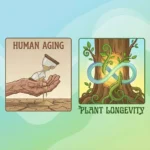
Look out your window at a towering oak tree. It might be 300 years old, yet every spring it puts forth fresh, vibrant green leaves that are biologically brand new. Now, look at a photograph of your grandparents when they were young. The contrast is stark and somewhat terrifying.
It is one of biology’s greatest puzzles and a question that has haunted philosophers and scientists for centuries: why humans age but plants don’t.
While a human centenarian is frail and near the end of life, a 5,000-year-old Bristlecone pine is still robust, producing cones and viable seeds. Why do we wither and fade while the green world seems capable of eternal youth?
The answer is not simple, and it forces us to confront the reality that the very premise of the question—why humans age but plants don’t—is slightly misleading. Plants do age, but they do it in a radically different way than animals. They possess biological “hacks” that allow them to bypass the cellular degradation that defines human existence.
In this deep dive into evolutionary biology, we will uncover the five incredible secrets that allow some plants to defy the ravages of time that inevitably claim us all.
The Ticking Clock: The Reality of Human Aging
To understand the immense difference between our lifespans and those of the botanical world, we first need to understand what is happening inside our own bodies. When we ask why humans age but plants don’t, we are usually referring to the visible and inevitable decline in function that humans experience.
Human aging is, fundamentally, a failure of maintenance. We are complex machines that run continuously for decades. Eventually, parts wear out, and our repair mechanisms begin to fail.
The Hayflick Limit and Telomeres
At the cellular level, humans have a built-in expiry date. In the 1960s, scientist Leonard Hayflick discovered that normal human fetal cells in a culture divide between 40 and 60 times before they enter a senescence phase—they stop dividing and eventually die. This is known as the “Hayflick limit.”
The mechanism behind this is the telomere. Think of your chromosomes as shoelaces that hold your genetic material. Telomeres are the little plastic aglets at the end that keep the shoelace from fraying. Every time a human cell divides, a tiny piece of that telomere is lost.
When the telomeres get too short, the cell can no longer divide safely. It becomes inactive or dies. This cumulative cellular senescence leads to aging tissues, organ failure, and the gray hair and wrinkles we recognize as getting old.
The Damage Accumulation Theory
Simultaneously, just living our lives causes damage. The process of turning food into energy in our mitochondria produces “reactive oxygen species” (free radicals). These are highly reactive molecules that damage DNA, proteins, and fats inside our cells—a biological form of rusting.
While our bodies have antioxidant systems to fix this, over time, the repair mechanisms cannot keep up with the damage. The “rust” accumulates, and the machine begins to break down.
Secret #1: Indeterminate Growth vs. Determinate Growth
Now we arrive at the first major divergence when exploring why humans age but plants don’t. It comes down to the fundamental blueprint of growth.
Humans, like nearly all animals, have determinate growth. You grow from an embryo to an infant, then a child, and finally an adult. Once you reach adulthood around age 20, your growth stops. Your skeletal structure is fixed. From that point on, your body is only maintaining what is already there, patching holes until it can’t anymore.
Plants possess indeterminate growth. Most plants do not have a fixed adult size. As long as the environmental conditions—sun, water, and nutrients—are favorable, a plant will continue to add new body parts. A 4,000-year-old tree is still growing new branches, new roots, and new leaves every single year.
This means that while an older human body is made up entirely of aging cells, an ancient tree is a patchwork quilt of old wood supporting biologically newborn tissues.
Secret #2: The Magic of Meristems (The Eternal Stem Cell)
How do plants achieve this indeterminate growth? The answer lies in a special type of tissue that makes human stem cells look lazy by comparison.
If you cut off a human finger, it will not grow back. We have stem cells, but they are mostly specialized to repair certain tissues like skin or blood.
Plants, however, have zones called meristems. These are located at the tips of roots and shoots (apical meristems) and inside the trunk (lateral meristems). These regions contain pockets of perpetually embryonic cells.
The Fountain of Youth at Every Tip
Meristematic cells are totipotent or pluripotent, meaning they retain the ability to divide and differentiate into any type of plant tissue indefinitely.
When we investigate why humans age but plants don’t, this is a critical distinction. A 2,000-year-old redwood tree has meristems at the very top of its canopy that are functionally as young as the day the seed sprouted. They have not undergone the same telomere shortening that ages human cells.
Because plants keep these reserves of “forever young” cells, they can constantly replace lost parts and expand their bodies in ways animals simply cannot.
Secret #3: Modularity vs. Unitary Bodies
Perhaps the most profound difference between human and plant biology is body architecture.
A human is a unitary organism. You are one cohesive unit with highly specialized, indispensable organs. You have one heart, one brain, and two lungs. These organs are deeply interconnected. If your heart fails, your brain dies, and the entire organism ceases to function. We are a house of cards; remove one crucial card, and the structure collapses.
Plants are modular organisms. A tree is not a single, indivisible individual in the same way a human is. Instead, a tree is a colony of repeating units—branches, leaves, and buds—all genetically identical but semi-autonomous.
The Survival Strategy of Partitioning
This modularity is a massive advantage against aging and death. If a specific large branch on an old oak tree gets diseased, is struck by lightning, or simply becomes too old to function efficienty, it can die and fall off without killing the rest of the tree.
The tree simply seals off the connection to that dead module and reallocates resources elsewhere. The “individual” parts of the plant die constantly, but the collective organism survives.
When thinking about why humans age but plants don’t, remember this: if your arm gets gangrene, it threatens your whole life. If a tree limb gets a fungal infection, the tree just drops the limb and keeps growing.
Secret #4: Different Responses to DNA Damage
We mentioned earlier that human DNA gets damaged over time by free radicals, leading to aging or cancer. Plants are exposed to even more DNA-damaging elements, particularly intense UV radiation from standing in the sun all day for centuries.
So, why don’t ancient trees become riddled with tumors?
Plants have evolved incredibly robust DNA repair mechanisms that are frequently more efficient than animal repair systems. Furthermore, because plant cells are locked in place by rigid cell walls, a cancerous plant cell cannot metastasize (spread) through the body like an animal cancer cell can.
If a plant cell mutates and becomes dysfunctional, it is stuck where it is. The plant can simply isolate that area and let it die, or even grow around it. The rigid structure that prevents plants from moving also protects them from systemic cancer.
Secret #5: The Evolutionary Trade-Off (Disposable Soma)
Why did evolution take such different paths? Why would nature design a human that falls apart in 80 years but a tree that lasts 5,000? The answer lies in evolutionary priorities.
The “Disposable Soma Theory” suggests that an organism has a limited amount of energy. It has to choose whether to invest that energy into maintaining its body (soma) forever, or into rapid reproduction.
Animals Move, Plants Stay
Animals are mobile. We move around to find food and mates, which exposes us to high risks of predation, accidents, and infection. In the wild, an early human or an antelope would likely be eaten or killed by an accident long before they reached 100 years old.
Therefore, evolution prioritized front-loading our biology. We are built to grow fast, reach sexual maturity quickly, reproduce, and raise offspring. Nature has no incentive to invest energy in building a body that lasts 500 years if it’s likely to get eaten by a tiger at age 30. Once we have reproduced, our biological utility to the species diminishes, and maintenance mechanisms are allowed to fail.
Plants are stationary. They cannot run from predators or bad weather. Their survival strategy relies on being incredibly durable, regrowing after being eaten, and outlasting periods of drought. For many trees, their best reproductive strategy is to become massive and occupy a space for centuries, dropping millions of seeds over millennia hoping just one takes root.
For a giant Sequoia, longevity is thereproductive strategy. For a human, speed and adaptability were the strategies.
Debunking the Myth: Do Plants Really Not Age?
Throughout this exploration of why humans age but plants don’t, we must address the nuance. It is not strictly true that plants do not age.
If you plant petunias or marigolds in your garden, they will grow, flower, set seed, and die all within a single year. These are called annuals. They have a very clear, genetically programmed senescence. Once they reproduce, they trigger a rapid, systemic shutdown analogous to animal aging, only much faster.
Even long-lived perennials (like trees) eventually die. They don’t live forever.
However, the way an ancient tree dies is different than a human. A 4,000-year-old tree rarely dies just because its cells got “too old.” Its meristems are still capable of producing new growth.
Ancient trees usually die due to physical limitations or external forces over vast stretches of time:
- Mechanical Failure: They become too big to support their own weight during a storm.
- Pathogens: A fungus or insect infestation finally overwhelms their defenses over centuries.
- Transport Failure: It becomes energetically too difficult to pump water from the deep roots all the way to the highest leaves hundreds of feet in the air.
So, plants do have an end, but for the longest-lived species, it is vastly different from the ticking cellular clock that governs humanity.
Lessons from the Green World
The question of why humans age but plants don’t is not just an academic curiosity. It is currently driving cutting-edge research in longevity and medicine.
Scientists are studying plant meristems to better understand stem cell regeneration. They are analyzing the robust antioxidant systems of long-lived pines to see if we can adapt their biochemical defenses for human use.
While we will never become modular organisms capable of regrowing a severed head, understanding the genetics that allow a Bristlecone pine to repair its DNA for five millennia might hold the keys to treating age-related diseases in humans, such as Alzheimer’s or heart disease.
Conclusion
The next time you walk through a forest, take a moment to respect the elders surrounding you. They have witnessed history we only read about in books.
The answer to why humans age but plants don’t is a fascinating journey through evolutionary strategy and cellular architecture. We age because we are unitary, determinate organisms built for a fast-paced, mobile life where longevity was never the primary goal.
Plants, particularly long-lived trees, are modular, indeterminate growers built for stationary endurance. Through the magic of meristems, they maintain perpetual reservoirs of youth, allowing them to constantly renew themselves even as the centuries pass. They are nature’s testament to a different way of being—a slow, steady, and incredibly resilient approach to the challenge of existence.
You Might like this…
Air Pollution Comparison to Smoking: 7 Shocking Reasons It’s a Dangerous Myth
References & Further Reading
- The Hayflick Limit & Cellular Aging
- Source: The Embryo Project Encyclopedia (Arizona State University)
- Topic: Explains Leonard Hayflick’s discovery that human cells have a finite number of divisions (40-60) before dying.
- Link: Aging and the Hayflick Limit
- Plant vs. Animal Stem Cells (Meristems)
- Source: MDPI (International Journal of Molecular Sciences)
- Topic: A deep dive into how plant meristems function as perpetual stem cell reservoirs compared to the limited nature of animal stem cells.
- Link: Stem Cells: Engines of Plant Growth and Development
- Indeterminate Growth in Plants
- Source: NCBI / PubMed Central (National Institutes of Health)
- Topic: An evolutionary analysis of why some organisms stop growing (determinate) while others grow indefinitely (indeterminate).
- Link: Indeterminate Growth: Could It Represent the Ancestral Condition?
- Why Plants Don’t Get Cancer
- Source: John Innes Centre (Independent Research Institute)
- Topic: Explains the biological mechanisms, such as rigid cell walls and lack of metastasis, that prevent plants from dying of cancer like humans do.
- Link: Controlling Cell Division: Do Plants Get Cancer?
- The Disposable Soma Theory
- Source: PNAS (Proceedings of the National Academy of Sciences)
- Topic: A study testing the evolutionary trade-off between reproduction and body maintenance (longevity).
- Link: Reproduction and the Disposable Soma Theory
- Oldest Trees in the World
- Source: Trees Atlanta
- Topic: Verification of the longevity of Great Basin Bristlecone Pines (Pinus longaeva).
- Link: The Oldest Tree in the World