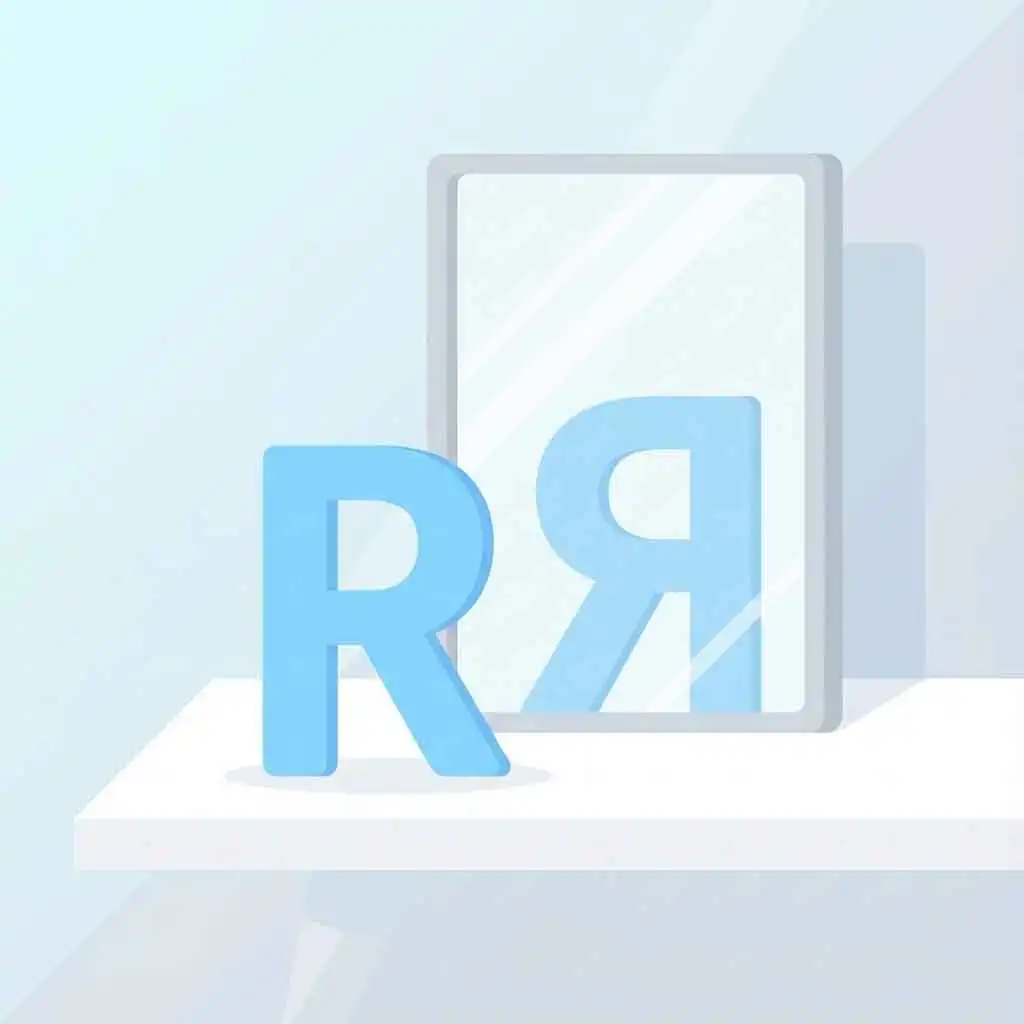
You stand in front of the bathroom mirror to brush your teeth. You raise your right hand, and the person in the glass raises their left. It is a phenomenon we accept without question every single morning. But if you stop to think about it, a confusing question arises: why mirrors reverse left-right but not up-down?
If a mirror has the power to flip things horizontally, why doesn’t it flip them vertically? Why aren’t you standing on your head in the reflection?
It feels like a riddle designed to break your brain. You might think it has to do with the way your eyes work, or perhaps gravity. The answer, however, is far simpler and yet more complex than you might imagine. It involves a mix of hard physics and the strange way the human brain maps the world.
In this comprehensive guide, we are going to deconstruct this optical illusion. We will explore the geometry of light, the invisible axes of the universe, and the psychological tricks your mind plays on you. By the end, you will never look at your reflection the same way again.
1. The Shocking Truth: Mirrors Do Not Reverse Left-Right
To answer the question of why mirrors reverse left-right but not up-down, we have to start with a shocking premise: they don’t.
Mirrors do not flip left to right. They do not flip up to down. They actually flip front to back.
The Stamp Analogy
Imagine you have a rubber stamp with the word “HELLO” on it. If you look at the face of the stamp, the letters are backward. When you press it onto a piece of paper, the letters come out reading “HELLO” correctly.
Now, imagine pressing that stamp onto a mirror. The mirror isn’t taking the ink and twisting it sideways. It is simply reflecting the light that hits it directly back.
When you stand in front of a mirror, you are like that stamp. The light from your nose hits the mirror and bounces straight back. The light from your right ear hits the right side of the mirror and bounces straight back to your right eye. The mirror is not crossing the streams. It is not taking light from the left and moving it to the right.
The Z-Axis Reversal
In geometry, we live in a 3D world defined by three axes:
- X-Axis: Horizontal (Left/Right)
- Y-Axis: Vertical (Up/Down)
- Z-Axis: Depth (Front/Back)
When you look into a mirror, the X-axis (your width) stays the same. Your right hand is still on the right side of the mirror frame. The Y-axis (your height) stays the same. Your head is still at the top.
The only thing that changes is the Z-axis. The reflection is a “Z-reversed” version of you. It is as if you were turned inside out along your depth. This is the fundamental reason why mirrors reverse left-right but not up-down is actually a trick question—the mirror isn’t reversing either of those dimensions!
2. The Psychology of “Mental Rotation”
If physics says the mirror doesn’t flip left and right, why does your brain insist that it does?
The confusion stems from our human anatomy. We are biologically symmetrical on the left-right axis. You have a left arm and a right arm that look roughly the same. However, you are not symmetrical up and down (your head is very different from your feet) or front to back (your nose is different from the back of your head).
The “Other Person” Theory
When you see your reflection, your brain instantly identifies it as “another human.” Because we are social creatures, we instinctively try to understand this “other person’s” perspective.
To match the image in the glass, your brain performs a mental gymnastic routine. It asks, “How would I have to move to look like that?”
There are two ways you could move to match your reflection:
- Rotation: You could walk behind the mirror and turn around 180 degrees to face the front.
- Inversion: You could do a handstand.
We rarely see people doing handstands. However, we see people turning around to face us all the time. So, your brain defaults to the “turn around” explanation.
When you turn around to face someone, your left hand is now on their right side. Because your brain applies this logic to the mirror, you perceive the image as being “flipped” left-to-right. This psychological shortcut is the primary reason we struggle to understand why mirrors reverse left-right but not up-down.
3. The Role of Gravity and Orientation
Let’s dig deeper into why we don’t perceive an up-down flip. It has to do with the environment we evolved in.
The Anchor of Gravity
Gravity gives us a permanent, non-negotiable definition of “down.” The floor is always down. The sky is always up. This reference frame rarely changes for us.
However, “left” and “right” are relative. If you turn 90 degrees, your left changes direction. Because “left” and “right” are fluid concepts compared to the absolute nature of “up” and “down,” our brains are much more willing to accept a horizontal reversal than a vertical one.
The Landscape Experiment
If you stand next to a calm lake, you see the mountains reflected in the water. In this case, the reflection is upside down. The top of the mountain is at the bottom of the reflection.
Here, the mirror (the water) is horizontal on the floor. When the mirror changes orientation, the axis of reversal changes relative to you. If you put a mirror on the ceiling and looked up, you would indeed perceive a different kind of reversal.
This proves that the phenomenon isn’t magic; it’s entirely dependent on the orientation of the reflective surface relative to your eyes.
4. Text and the “Ambulance” Phenomenon
One of the most common places we notice this reversal is with text. We all know that if you hold a book up to a mirror, the text is unreadable. And we’ve all seen the word “AMBULANCE” written backward on the front of emergency vehicles so that drivers see it correctly in their rear-view mirrors.
This reinforces the question: why mirrors reverse left-right but not up-down regarding text?
The Paper Flip
Take a piece of paper with a word on it. To show it to the mirror, what do you do? You flip it around.
You usually flip the paper horizontally (like turning a page in a book). By physically turning the paper 180 degrees around the vertical axis, you are the one who reversed the text, not the mirror. You presented the mirror with reversed text, and it faithfully reflected exactly what you showed it.
If you were to flip the paper vertically (top-to-bottom) to show it to the mirror, the text would appear upside down in the reflection, but the letters would be in the correct left-to-right order.
Try it. Write a word on paper. Flip it top-over-bottom to face the mirror. You will see that the mirror didn’t choose to reverse left-right; it just reflected the orientation you created.
5. The Camera vs. The Mirror
To fully grasp why mirrors reverse left-right but not up-down, it helps to compare a mirror to a camera/video screen.
When you take a selfie with a smartphone, the preview screen often acts like a mirror—it flips the image so it feels natural. But when you snap the photo and view it in your gallery, it often “flips back” to the true image (what others see).
The True Image
A photograph shows you what you look like from the perspective of an observer. In a photo, your right hand is on the left side of the picture frame.
A mirror shows you a “virtual image.” It preserves the side. If you wink your right eye, the eye on the right side of the mirror winks. If you looked at a clone of yourself standing opposite you (a real person, not a reflection) and you winked your right eye, it would be the eye on your left (their right) that winks.
This distinction is why many people dislike photos of themselves. They are used to the “Z-axis reversed” version of their face they see in the mirror every day, which is slightly different due to facial asymmetry.
Why This Matters in Science and Design
Understanding why mirrors reverse left-right but not up-down isn’t just a party trick; it has real-world applications in design, driving, and even dentistry.
Rear-View Mirrors
Car mirrors are convex to give a wider field of view, but they rely on the driver quickly interpreting the Z-axis reversal. If mirrors actually flipped things randomly, driving would be impossible. We rely on the fact that “right in the mirror” means “right side of the car behind me.”
Dental Mirrors
Dentists use small angled mirrors to see behind teeth. They have to train their brains to work in a Z-reversed environment. To a novice, moving a drill in a mirror is incredibly difficult because your depth perception is inverted.
[Internal Link: Check out our article on Optical Illusions and Brain Training here]
Common Misconceptions Table
Let’s break down the complex ideas surrounding why mirrors reverse left-right but not up-down into a clear comparison.
| The Misconception | The Scientific Reality |
| Mirrors flip left and right. | False. Mirrors reflect light straight back (Front-to-Back reversal). |
| Mirrors don’t flip up and down. | True, because the Y-axis is parallel to the mirror surface. |
| The mirror “knows” to flip horizontal. | False. The mirror is an inanimate object reflecting photons based on the angle of incidence. |
| It is a property of light. | It is actually a property of geometry and human perception (mental rotation). |
How to Break the Illusion (A Fun Experiment)
If you want to prove to yourself that the mirror isn’t flipping left-right, try this simple experiment at home.
- Get a Glove: Put a glove on your right hand.
- Stand at the Mirror: Stand with your right side touching the mirror.
- Look closely: The reflection of the glove is touching the real glove.
- Trace the line: Imagine a line going from your real hand into the mirror.
You will see that the “fingers” of the reflection are pointing in the exact same direction as your real fingers. The thumb is on the same side. There is no left-right swap. The swap only “happens” when you turn your body to face the mirror and your brain tries to interpret the reflection as another person facing you.
Conclusion: The Reflection Deception
The question of why mirrors reverse left-right but not up-down is a classic example of how our brains construct reality. The universe is built on XYZ coordinates, but our minds are built on social cues and gravity.
To summarize:
- Mirrors fundamentally reverse the Z-axis (front-to-back), not the X or Y axes.
- We perceive a left-right reversal because we mentally rotate our bodies to match the reflection.
- We do not perceive an up-down reversal because gravity provides a fixed reference point we rarely rotate against.
So, the next time you look in the mirror and admire your outfit, remember: you are looking at a Z-reversed phantom, a geometric trick of light that your brain is frantically trying to make sense of. The mirror isn’t confused—you are.
External References
- Physics Stack Exchange – Why are mirror images flipped horizontally?
- Scientific American – Why do mirrors reverse left and right?
Recommended Video
… Why do mirrors flip horizontally (but not vertically)? …
This video by Physics Girl provides an excellent visual demonstration of the Z-axis reversal and the “stamp” analogy discussed in this article.
You might also like this…
Air Pollution Comparison to Smoking: 7 Shocking Reasons It’s a Dangerous Myth